Contrastive Explanation
Contrastive Explanation Graph
The contrastive explanation graph is asplain's central representation of an explanation. It contrasts the reference program and its model with the found foil, making the differences between both worlds explicit. Since the graph is directed, edges can express the cause-effect relationships of the program, which makes the explanation easy to follow. This page describes how the graph is constructed, how it is represented as facts, and how to read its visualization.
The graph is annotated with membership information that captures the differences between the reference and the foil world:
- Program membership assigns each rule node the programs it occurs in: the reference program, the foil program, or both. Rules only in the foil were added during foil finding, rules only in the reference were removed.
- Model membership assigns each atom node the models it holds in: the reference model, the foil model, or both. It is extended to rule nodes, indicating whether the body of a rule is satisfied by the respective model.
Fact Representation
asplain represents the contrastive explanation graph as a set of facts, which serve as the interface for pruning, visualization, and the LLM-based natural language explanations. The following predicates are used:
| Predicate | Meaning |
|---|---|
node(N, T) |
N is a node of type T, where T is atom, rule(choice), or rule(disjunction) |
edge((X,Y), S) |
Directed edge from X to Y with sign S, where 1 is positive and 0 is negative |
program(R, W) |
Rule R is part of the program of world W, where W is ref or foil |
model(N, W) |
Node N is satisfied by the model of world W |
query(A, V) |
Atom A is part of the query with truth value V (1 for positive, 0 for negative) |
optional(C, R) |
Rule R is a change candidate, where C is add or remove |
fired(R) |
Integrity constraint R is fired |
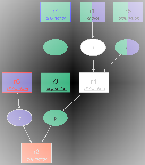
James bond program graph
For the James Bond example with the query p ("Why is Bond not poisoned?"), asplain finds a foil in which the fact c (Bond is careful) is removed and the addable fact t (contact with toxin) is added.
The resulting contrastive explanation graph is represented by the following facts:
query(p,1).
optional(add,7).   optional(remove,6).   optional(remove,5).

node(1          , rule(choice)).
node(2..7       , rule(disjunction)).
node((a;p;c;t;d), atom).

edge((1,d),1).
edge((p,2),1).  edge((c,2),1).
edge((3,p),1).  edge((t,3),1).
edge((4,p),1).  edge((d,4),1).  edge((a,4),0).
edge((5,a),1).  edge((6,c),1).  edge((7,t),1).

program(1..5, ref).     program(6, ref).
program(1..5, foil).    program(7, foil).

model((c;a)  , ref).   model((1;6;5)  , ref).
model((t;c;p), foil).  model((1;3;6;7), foil).

fired(2).
Fired Constraints
The body of an integrity constraint can never be satisfied by a single model, so its model membership is always empty. Nevertheless, constraints often encode the relevant domain knowledge behind an explanation. To capture their impact, asplain marks a constraint as fired if its body would be satisfied when the reference and foil models are considered simultaneously. Informally, these are the constraints that would have been violated under specific changes to the reference program, and they frequently are the reason why a change was necessary in the first place.
Visualization
asplain visualizes contrastive explanation graphs using clingraph, either directly from the command line or interactively in the user interface. The membership information is conveyed through color and style highlighting:
| Element | Meaning |
|---|---|
| Rectangle node | Rule (labeled choice or disjunction) |
| Ellipse node | Atom |
| Solid edge | Positive body literal or rule-head relationship |
| Dashed edge | Negative body literal |
| Purple fill | Satisfied by the reference model |
| Green fill | Satisfied by the foil model |
| Purple-green fill | Satisfied by both models |
| White fill | Satisfied by neither model |
| Red fill | Fired integrity constraint |
| Blue border | Rule added in the foil |
| Red border | Rule removed in the foil |
Hovering over a node in the interactive interface shows a tooltip with the underlying rule and its @label tag if one was provided.
With this highlighting, the example graph above can be read as: James would be poisoned if he hadn't been careful and had been in contact with a toxin.
Reducing the Graph Size
For complex problems the explanation graph can grow to a size where interpretation becomes difficult. asplain offers two mechanisms to keep the graph focused: